Who are the Zapatistas and how are they organising?
Zapatism and rebellious communities
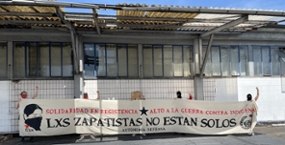
Zapatistas are rebellious indigenous people and communities in Mexico. They adopted the name and slogan 'Tierra y Libertad' (Land and Freedom), inspired by revolutionary hero Emiliano Zapata (1879-1919). In his name, they are fighting oppression, land seizure, capitalist conditions, neoliberalism, and the free trade agreement NAFTA and its consequences in particular.[1]. They are organised in EZLN (Ejército Zapatista de Liberación Nacional), the Zapatista Liberation Army, and in five so-called Caracoles, regional assemblies and councils in the communities.
When the free trade agreement NAFTA came into effect, import taxes for nearly all agricultural products were abolished, resulting in the foreseeable effect of Mexico being swamped by cheap US products. Ever since, Mexican small-scale farmers have competed without a chance against US major landowners and farming industries. Their livelihood has been destroyed which had been conceivable even before the agreement: 'with NAFTA, they will kill us without bullets.'[2]
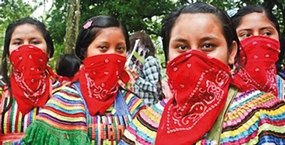
Armed rebellion, wearing the famous balaclavas, took place on 01/01/1994, the day NAFTA came into effect, after more than ten years of underground preparation and decades of struggle for acceptance and land. They described the taking up arms as a 'means of desperation' [3] and as an 'uprising of dignity'. Following the slogan 'Ya basta!' ('Enough!'), five cities were squatted.
Violence, corruption and lawlessness in Mexico
For twelve days, the EZLN was defending against attacks by the military and the police. The government sent 17,000 soldiers to defeat the uprising by military means. The Mexican population showed solidarity with the Zapatista demands and held large demonstrations across the country. The PRI, in power since 1929 as a single political party, was finally forced to proclaim a truce, followed by the end of the EZLN's armed resistance, which, in effect, continues today. Due to government parties' paramilitary forces, the context of organised crime and the massive presence of the military to this day, there is a frequent occurrence of assaults, murders and crimes against human rights.
A figure illustrates violence all over Mexico: on a national level, currently 30 000 people are supposed to have vanished – more than during the dictatorships in Chile and Argentina. Corruption is prevalent, and local police are cooperating with drug cartels more often than not. Murders of women are happening so frequently that there is a special name - they are called feminicidos. Well-known community and union activists, and last but not least journalists reporting this situation, are killed regularly.
Changing the world without assuming government power
Zapatista political demands are reaching far beyond resistance against the NAFTA agreement. One popular slogan is 'All for everyone – for us nothing!', summing up the struggle and the demands: radical social equality. They renounce privileges in access to resources, even for themselves. The struggle does not focus on identity-based groups but on the benefit of all. Rallying around an anti-state, anti-hierarchical concept, Zapatistas differ greatly from traditional liberation movements defined by their reference to parts of the (national) territory. They don't demand national liberation or independence, but autonomy and self-administration as a local base for global change.
Zapatistas perceive themselves as part of global relations, of a 'capitalist Hydra' to be changed. According to Marcos, this is necessary because the '4th World War' [4] has already begun, accumulating poverty through neo-liberalism worldwide. In their struggle against this war, they are not acting as an armed party in this conflict or pursuing civil war; instead, they are organising self-defence against ubiquitous violence, relating to the population's interests and needs, and targeting international networks. Hence, two international assemblies (1996/97) welcoming thousands of activists and left-wing intellectuals have been held, providing substantial impulses to the globalisation-critical movement.
The Zapatista movement aims to bring about social change without assuming governmental power. The emphasis is on a thorough overthrow of society and on women's liberation. It doesn't attempt to conquer and seize state structures but instead creates grassroots democratic alternatives.
'With questions, we are moving forward' – Zapatista self-organisation.
Following negotiations between the Mexican government and the EZLN, the San Andrés Agreement on the rights and culture of the country's 62 indigenous population groups was signed in 1996. This agreement, along with land reform under the Mexican Revolution's constitution, has never been put into practice. Paper is patient, as the saying goes, but given their experiences, Zapatistas weren't willing to wait forever. Unilaterally and without the government's consent, they began to implement the agreement's spirit in the communities.
As a result of the rebellion, up to 30 counties were governed autonomously, and communities undertook the spirited civil construction of an alternative economy. Autonomously governed regions are structured into five Caracoles (snail shells, meaning also centres) acting more or less independently of each other. Surrounding Municipios (counties) are assigned to the respective Caracoles. Caracoles serve as communication and logistics centres for their respective regions. They often have infrastructure for international guests, providing space for mutual exchange.
Additionally, there are collective shops, workshops, cultural institutions and occasionally secondary schools and health stations. Moreover, the Junta de Buen Gobierno (council of good government) meets in the Caracoles and decides each region's fate democratically. The Junta consists of elected community members from the municipios. All elected representatives are subject to the principle of obeying government: if the communities are not served satisfactorily or if unaccountable action occurs, persons can be removed from office immediately. Furthermore, all representatives rotate regularly. This is supposed to result in as many people as possible knowing self-administration and, at the same time, preventing corruption and abuse of power.
'Here, the government is obeying, and the population is governing' – grassroots democracy as a principle.
Besides junta meetings, communities hold general assemblies to decide important issues of community life. This also applies to EZLN issues. This ensures all decisions are made in accordance with the basis.
A grassroots democratic approach and practical testing of autonomous political organisation require time and patience (political centres being called snail shells is no coincidence). The motto 'With questions, we are moving forward' illustrates the approach and practice of reflection and questioning of their own political practice.
Yet, this practice has enabled numerous achievements and improvements in the social situation overall. Hospitals, community centres and an educational system operating schools in nearly all communities have been established. Education, literacy, and the population's health have improved significantly. Additionally, the region has suffered far less from crime than other parts of the country. Furthermore, women are occupying crucial positions in community administration and EZLN organisation. Special education and information campaigns are underway. Women's collectives have been organising workshops and, in March 2018, have called for an international network meeting of and for women, lesbians and transgender people fighting under different conditions for their rights all over the world.
Significance for anti-globalisation and post-colonial movements
The Zapatista struggle, gaining so much influence and standing its ground to this day, despite the military's overwhelming power, is astonishing. John Holloway is dubbing the Zapatista movement as 'absurd' in a positive way because it is backed by the poorest and most disadvantaged and discriminated population stratum in Mexico.
Their attempt to implement emancipatory ideas in practice and to locate their own conditions globally gave the Zapatistas international connectivity and a broad base of supporters. From this perspective, global processes of exploitation operate similarly across all people. Still, we cannot oppose this logic with equal force and similar action everywhere. Therefore, we must develop our own approaches and perspectives and fight local struggles without losing sight of global contexts. To create the world anew in the spirit of emancipation and to fight for the not-yet presently.
Additionally, Zapatism offers a fruitful point of reference for movements beyond party policy, particularly because it understands critical self-questioning as an essential part of the struggle. In the summer of 2005, the 'Other Campaign' was initiated. This association of more than 1000 organisations was supposed to create a 'really left-wing' anti-capitalist alternative through long-term, bottom-up mobilisation 'for the base', opposed to party policy and parliamentarianism.
In 2017, indigenous activist Marichuy was nominated as presidential candidate by EZLN and CRI, a nationwide council of the indigenous population. This candidacy was not about winning the elections. Still, it was supposed to illustrate the threefold impossibility of a poor, indigenous and female person becoming president according to Mexican society's imagination and to expose the underlying racism and sexism. 'There has never been any change for indigenous people, no matter whether right- or left-wing politicians have been in power.' was proclaimed in one statement. Therefore, neither a manifesto nor a party backed the candidacy. Marichuy has always emphasised that the only institution she represents consists of 130 representatives from communities, town quarters, and indigenous peoples: 'They have elected me because the entire collective cannot run for election'. Many of her speeches and statements have been composed and adopted by community consensus.
In a meeting at Mexico City University, she said that, had indigenous people had the idea to nominate a presidential candidate ten years ago, Subcomandante Marcos probably would have taken the stage. But today, the world-famous Zapatista speaker is a normal member of his community; however, Marichuy has been an activist in solidarity with the Zapatistas from the very beginning. It's not a coincidence that, in the face of assaults and attacks, she was exclusively accompanied by women: 'Don't doubt it: Women's time has come and we are going all out', she was proclaiming, given the murders of women and racism still prevailing in Mexican society. In March 2018, after the candidacy campaign, the first international meeting of fighting women took place in the indigenous Zapatista communities. The development of extra-parliamentary movements and community autonomy, as well as the creation of solidarity networks that question and learn from each other, remain the basis of the Zapatista uprising of dignity.
[1] North American Free Trade Agreement between Canada, the US and Mexico
[2] Subcomandante Marcos en: Marta Durán de Huerta (1994/2001): Yo Marcos. Gespräche über die zapatistische Bewegung, p. 94
[3] ibid., p. 48
[4] Subcomandante Marcos (1997): „Der vierte Weltkrieg hat bereits begonnen.“ In: Le Monde Diplomatique (German edition)