Outlook
Coffee for the daily uprising
We do not have a ready-made answer to capitalist conditions. In a globalised world shaped by capitalist principles, options for fair or solidary trade are necessarily limited. A solidary economy, therefore, cannot confine itself to enforce better prices within the intrinsically wrong system of world trade. Consequently, supporting social movements and protests is vital. Coffee projects built on solidarity aren't neutral, and they are not only to be found in shops and cafés but, at best, in the streets.
Further problems can arise from widening social gaps in communities if coffee is relatively well paid compared to foods like corn or beans. In the worst case, isolated markets will encourage monocultures and dependent labour. Therefore, it is important to develop trade and production models that support biodiversity, cooperatives' independence and autonomy, and the redistribution of revenue to as many community members as possible, e.g. via infrastructure grants.
Producers' auto-certification and self-marketing will also become increasingly significant in the future. The more value added remains in the production countries, the more sustainable conditions will be, even globally. Supporting quality development and education will gain even more importance. Solidary trade promotes the self-empowerment of small-scale farmers, cooperatives, and consumers. At best, it will make itself redundant to allow for an entirely different whole.
Numerous players in fair and solidary trade pursue close cooperation with co-ops based on solidarity. Concepts vary, but associations and organisations are united by the intention to develop alternative forms of trade and to generate more value added in production countries. It doesn't matter whether you buy your coffee at Café Libertad Kollektiv or at other solidary or fair traders. But it is essential not to rely on seals alone. Some organisations and corporations are more involved in greenwashing than in developing real alternatives to world trade.
Even big corporations have jumped on the bandwagon and converted to 'fair' trade to benefit from its positive image. As the certified coffee market share increases, criticism of this type of alternative trade is intensifying as well. A large share of the value added in fair-trade products is realised not in production countries but primarily in the processing and marketing sector. Small-scale farmers complain about low and stagnant minimum prices. Additionally, bureaucratic obstacles and a lack of controls favour bigger suppliers. Associations and cooperatives in production countries are criticising inefficiency and limited participation in large certification organisations and are developing regional auto-certification.
In practice, because of these structures, fair products tend to differ less than desired from the general mechanisms of the raw coffee world market. They are becoming their own high-price segment within these structures, precisely because of their economic success. Nowadays, fair coffee is often traded much like conventional coffee in major trading hubs worldwide. Additionally, supermarket distribution channels are subject to market forces, i.e., rigid pricing and purchasing policies, despite an ecological or socially acceptable facade. Consequently, it's worth looking closely at where your coffee comes from, how it has been produced and where it is sold - even if it is displaying a seal.
An integral part of Café Libertad Kollektiv's policy is to forgo production and distribution through intermediaries like supermarket chains. The more direct and transparent the coffee's way to the consumer, the better the economic and political conditions. Hence, it is possible to work more sustainably and with greater autonomy, and to build closer cooperation among small-scale farmers, producers, and consumers as a model of solidary agriculture.
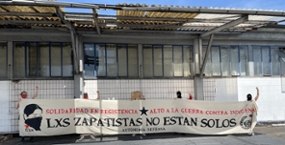
Furthermore, 'Coffee for the daily uprising' stands for a close connection with oppositional and resistant groups, supporting them and being part of local struggles and social movements around the world. We are not into lobby politics or pleading with established political institutions; instead, we support, as directly as possible, emancipatory self-organisation and the development of resistant economies as a base for social struggle.